
 Israel, United States 2025, 55/74 min, HD
A Deux Beaux Garçons Production
by Omer Shamir
 REQUEST A SCREENING
 Know Hope
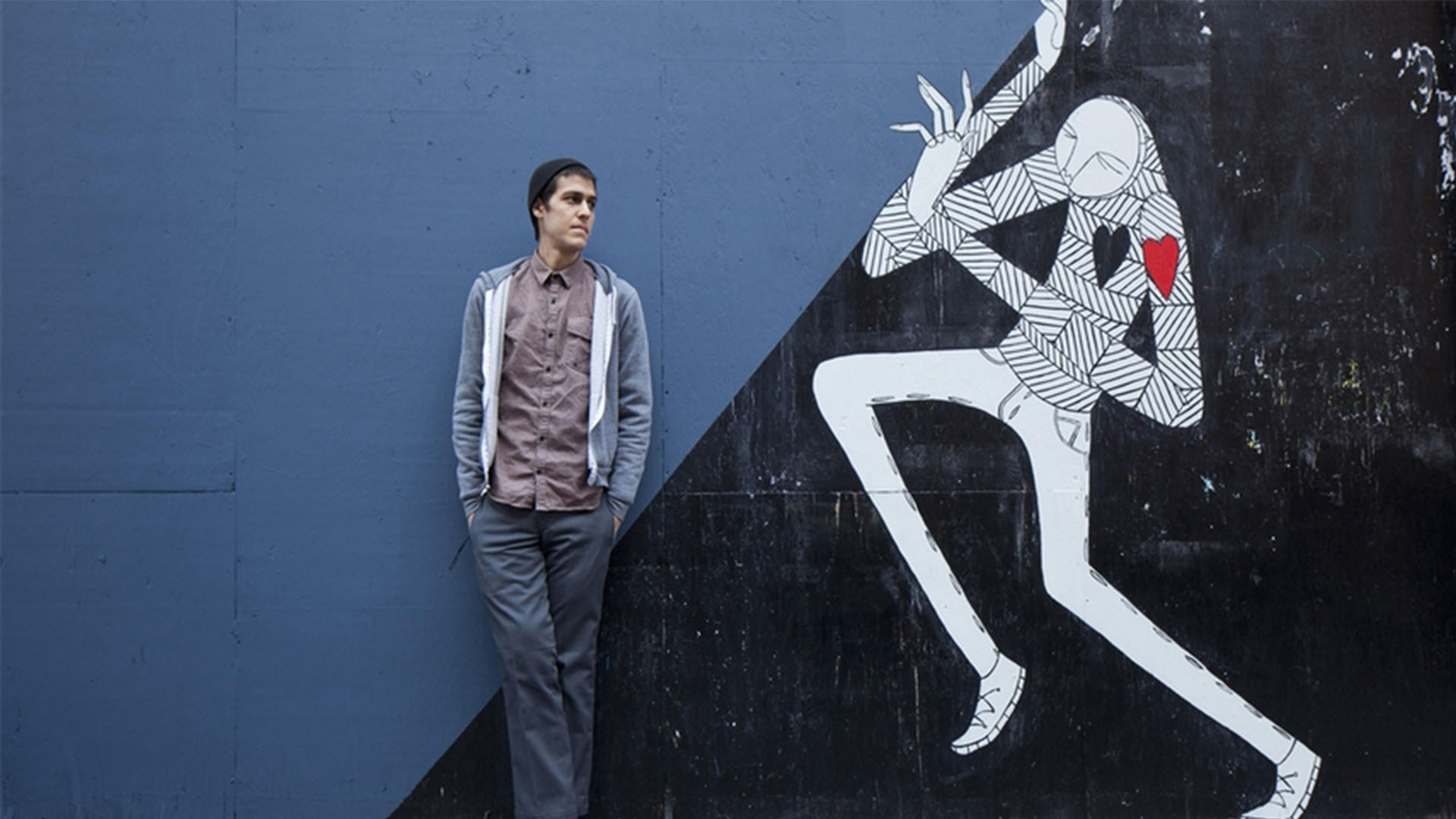
Using his work as a form of resistance in Palestine-Israel, street-artist Know Hope fights the ongoing genocide. When he faces chronic illness, his murals become a self-fulfilling prophecy. His disease, like the disease of the land on which he steps, walks the line between hope and despair.Addam Yekutieli kept his anonymity and signs his works with the pseudonym “Know Hope”. He began drawing human-like characters that rapidly gained public attention, granting him the title as a “local Banksy”.
When he experiences an eruption of an autoimmune arthritis, he is forced to rethink his artwork in light of his new physical disability, and begins documenting his immediate surroundings, finding inspiration in the poetry of the streets. His footage and observations turn back into street-art.
Narrating, he recalls his childhood in California, as a child of a Japanese-American mother and an Israeli father. When the family moves to Tel Aviv into a new culture and language, Addam feels estranged, an outsider.
As he reflects on his split identity, his refusal to enlist to military service amplifies his sense of alienation. Know Hope begins to scribble sentences in public space: open-ended English phrases, poetic and enigmatic. It allows him to work briskly with little physical effort.
The sentences he writes develop a presence, but they are also ephemeral, quick to vanish from public space. He decides to bring these texts to life and begins a new participatory project in which he tattoos texts from the streets on peoples’ bodies, provided with their full consent and cooperation.
These encounters evolve into relationships and drive Know Hope to reveal his true identity for the first time. Now they are carrying his work on their body and his texts will continue to live with them, creating new meanings, as time goes by. while Addam undergoes knee and hip replacement surgeries, limping and aching.
The deterioration of his physical condition and his multiple bodily scars sparks an idea for a new project — “A Body of Land”. Addam collects over 100 participants’ scarred-stories from Israel and Palestine.
Enriched by these materials, Addam re-imagines maps and borders — a political cartography of the stories he has collected. He prints large photos of the scars and draws them in public spaces, along the 1967’s so-called green line, on the sand and around hills and valleys. He finds his way through political art, moving beyond representations and drawings, leaning deeper into the real life of people.
Then October 7th hits. In the midst of it all Addam keeps searching for ways and means of telling the personal stories of individuals, looking for a different angle into the relationship between art and politics. As the genocide in Gaza intensifies, his work becomes even more urgent.
The film documents moments in which a personal human drama generates art and political action. In this process, we discover the uniqueness of a person who is dealing with pain, nostalgia and otherness. The anonymity of the hit-and-run street artist is replaced with intensive and intimate social interactions, exploring how painful memories and experiences may be alleviated through art.
Doc Aviv (Winner Best Documentary), Kassel Dokfest, This Human World FF Vienna, Yesh Zurich FF, Jewish Film Festival Berlin and Brandenburg (Competition)